Dev Diary #2: A Game Made of Cubes
The First Versions of the Game
Last time I promised more specifics. For this part I rolled the project back through its change history, launched the old versions of the game and captured frames exactly as everything looked at that moment, without repainting anything. When I got to the very first versions, it turned out that the terrain file from those days was corrupted in the history, and I had to regenerate the map with the same generator that made it back then.
The first thing these frames show: in the first days there isn't a single pretty picture in the game, just cubes. For an environment artist that's unusual, since I normally start with mood, light and silhouettes. But here I deliberately drew nothing until the game worked in grey.
September 18, 6 PM. Two Squads of Cubes

The screenshot shows the very first launch: an empty field and two squads of cubes, blue and red, that you can move with the mouse. The most important thing here is the line in the top-left corner. In an online strategy game, players' computers don't send each other tanks and explosions, they send only orders, for example "this squad, go there" or "build a factory here". Every computer simulates the whole battle on its own, and the result must match for everyone down to the last digit. If a tank drives through for one player but gets stuck half a pixel short for another, the match falls apart. The line in the corner is the world's "fingerprint", compared between players at every step. That's why I first needed a skeleton I could trust, and beauty came later.
The First Battle the Same Evening

In one evening the cubes learned to find paths, steer around each other, shoot, gather resources and build, and the fog of war appeared. The screenshot is from around 11 PM and shows the first "tank". The ground is a checkerboard because the texture was hooked up fifteen minutes after this frame, and everything black around it is hidden by the fog of war. As an artist it hurts to look at, but at that moment it was more important that squads didn't get stuck on each other.

By midnight the boxes looked like a base: a headquarters and the first structures, and the interface got money, power and a minimap. They're still placeholders, but each already has the right size and its own place. It's basically the same as a level blockout: first we check how the space works, and only then dress it.
The Game Against AI

Over the next couple of days came three factions, aircraft, garrisons in buildings, stealth units, superweapons and an AI opponent. In the screenshot from September 22, four computer players are fighting each other while I watch the match replay. At the bottom you can see messages that the enemy used "Ambush" and "Artillery Barrage". In the corner is a panel where the AI writes what it currently sees, what it's thinking and what order it's giving. When something goes wrong, it shows not only what the AI did, but why. All of this is still cubes, and I'm fine with that: if the game works with cubes, the art will amplify it later rather than hide the problems.
From Concept to Blockout
Only when the skeleton stopped breaking did I go back to my usual work. The process is familiar to any artist: a concept, a blockout based on it, then the final model.

The first screenshot is a concept of the buildings of one of the factions.

The second is a blockout of the command center based on that concept. A script builds it right inside Unity. The shapes are simple, but the proportions, silhouette and moving parts are already there: the radar spins, turrets rotate, gates work. It's not final art yet, it's a fitting: does the building fit its cell, and does its silhouette read from camera height.

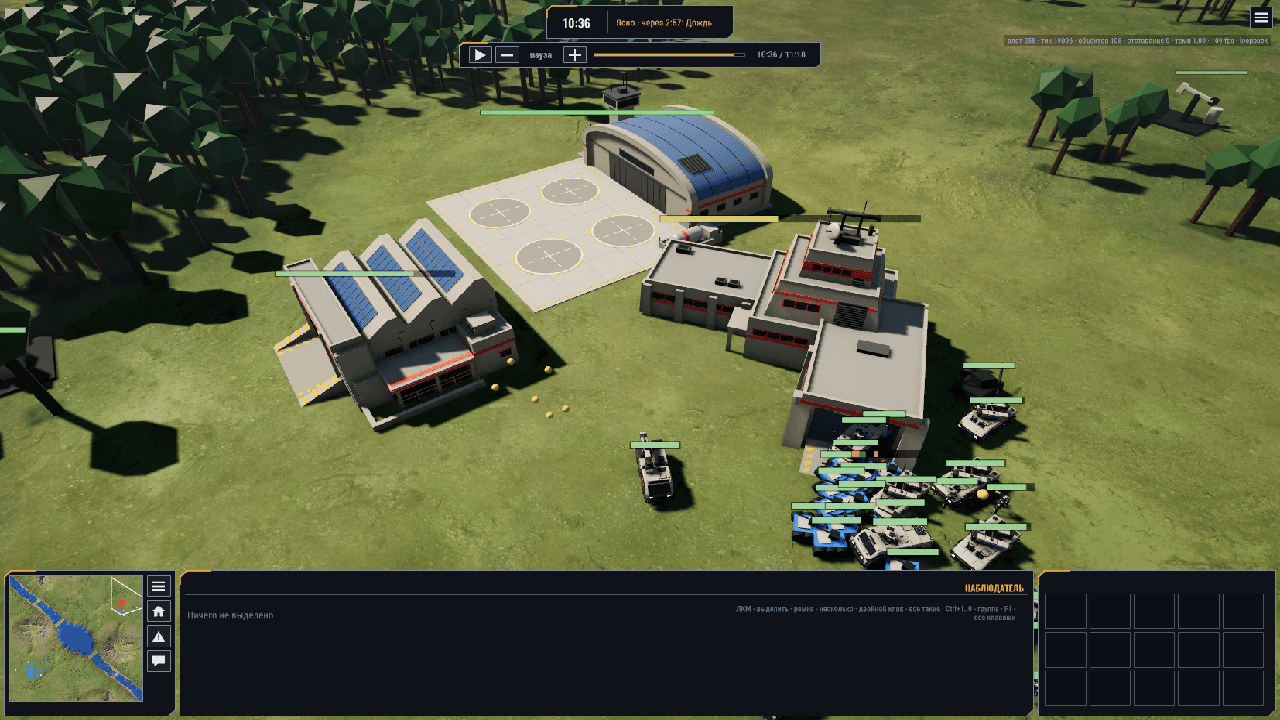
And the same command center already in the game. What the world around it has become, I'll show in the next parts.
What's Next
In the past I would have started with a pretty screen and a pretty model, and two weeks later I'd be stuck in code that couldn't be fixed. This time the order is reversed: first cubes that work, then form, then beauty. Cubes look boring, but they immediately show where the game works badly. In the next part I'll talk about maps: where the rivers, fords, forests and mountains in the game came from, and why I wanted to build a map editor in the spirit of World Machine.