Dev Diary #7: Three Sides and Their Bases
In this part I talk about the three sides of my game as a whole and about how their bases appear: from the formula of a side to the first building models in the game. Until now my screenshots showed placeholder cubes, but now for two of the three sides the buildings are made from concepts and already stand in the game, and for the third one they are in progress. A reservation right away: these are not final models. The materials are still rough, some details are simplified and everything will still change, but they already show what each side looks like.
How the Sides Differ
In the last part I said that the sides must not differ only in the price and strength of units, so each of them has its own way of playing, and I build everything else from it. AEGIS sees and hits precisely: its army is small, expensive and tough, its base needs energy and communications, and the side is strongest in the middle of a match. PACT spreads out and replaces losses: its army is large and cheap, its base consists of many autonomous sites on solar panels and generators with no common network, and the side is strong at the start of a match. VARDEN holds and presses: its army is heavy, the side has forward bases and returns part of the cost from wreckage, and it is strongest at the end of a match. Each side has a weak spot too: for AEGIS it is expensive losses and dependence on reconnaissance, for PACT fragility in a head-on clash, for VARDEN a slow start. And each has its own superweapon: AEGIS has the “Combined Strike” on the targets it has spotted, PACT has the “Swarm”, VARDEN has the “Rampart”, a strip of heavy fire. I accepted this formula on October 1, but the numbers and mechanics inside it are still only proposals.
One of the rules of the formula says that a side must be recognizable by its base. The player should understand who they are playing against from the first buildings, before the first shot. So after the formula I turned to how the buildings look.
How I Want Each Side's Base to Look
I described VARDEN as a factory state: the base looks like a workshop that never stops, made of heavy cast steel with ribs, chimneys and rails.

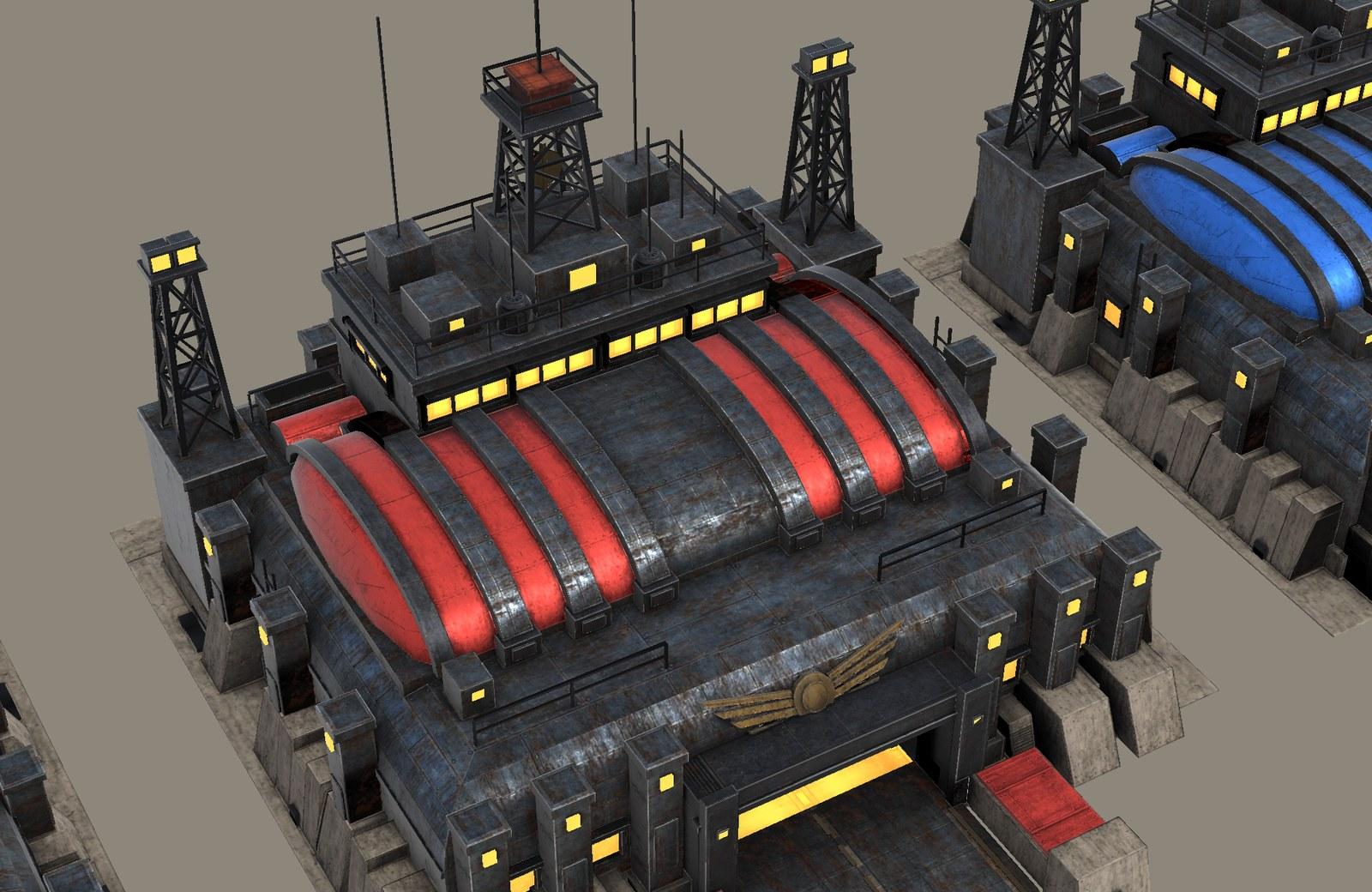
The screenshot shows the VARDEN headquarters. You can see a long body with red ribbed vaults along the roof, a command superstructure with masts above it, lattice towers with lit windows at the edges of the roof, and a wing with a sphere above the entrance. Red here is the player color.
I described AEGIS as an expensive corporate army that flew in, deployed and sees everything. That is why its buildings stand on supports, as if they had been brought by air.

The screenshot shows the AEGIS power station: two horizontal turbine units in smooth light panels standing on a common black frame and supports, cooling grilles on top, a short chimney at the front and a row of white and blue lights along the bottom. The red stripes here are also the player color.
PACT is cities that learned to live without someone else's network, so its base is built from ordinary modern city infrastructure: light concrete, glass and solar panels on the roofs. My first concept came out toy-like: a lot of small clutter around, bright containers, thick yellow railings. I rejected it and rewrote the description so that the proportions are real and there are no extra objects around.

The screenshot shows the PACT coordination center: a two-storey block with panoramic glazing of the hall, solar panels and a lattice communications mast on the roof, and a sign of three rings on the facade. The camera angles and scale on these three frames are different, and the buildings are of different sizes too, so they can't be compared by size, only by character.
How a Building Gets Into the Game
A building is made in several steps. First I write a description: how it looks, what moves in it, and how much space it takes on the map. From the description a neural network draws a concept sheet: four views in isometry, the way the game camera looks, and a top view from which the dimensions are taken. Then an AI agent assembles the model in Blender with a script from this sheet, and I accept the result by the picture. I require the silhouette and the number of details to repeat the concept, and after every pass the render of the model is compared with the sheet in every view. First comes the pure form without materials, then the UV unwrap and the material. The material is layered: a painted layer based on the concept plus a shared set of free textures of metal, concrete and rust, which repeat as tiles measured in meters. In the end the model is exported to Unity together with its moving parts and attachment points.

The screenshot shows the VARDEN factory in four steps. Top left is the concept sheet, top right is the form in Blender without materials, bottom left is the same model with the material, bottom right is the building in Unity with a red player color. The general form is kept: the ribbed vault, two chimneys, gates with braces, rows of windows along the side wall. But there is no smoke above the chimneys on the model yet, the roller conveyor in front of the gates is shorter than in the concept, and some of the small units around the building are simplified. This model has 6174 triangles, and it takes 9 by 9 cells on the map, which is about 25 meters at the game scale. The other buildings fit roughly within the range of 4 to 8 thousand triangles.

The PACT buildings are made the same way. The screenshot shows the PACT barracks: the concept on the left, the model in the game on the right. The U-shaped plan around a courtyard, the outer staircase, the tree in the courtyard, the panels on the roof and the sign on the end wall are kept. There are several differences: in the concept the accents are turquoise, while in the model they are red, because that is the player color, the windows in the model are still flat pale rectangles without glass, and the trees in the courtyard are rough polyhedrons. The camera on the right frame stands closer and lower, so the model looks bigger.
The Player Color
The models have a separate player color zone: stripes, rings, panels, everything that is painted in the accent color of the side in the concept. Because of this the same model gets the color of any team without a separate copy.

The screenshot shows three copies of the VARDEN factory: the green, red and blue team. The red factory has its gates open and the opening is glowing, this is the “working” state. On the left stands the old building of this side for scale, it doesn't have a new model yet.

The same for AEGIS: on the left is the gray old building without a new model, then three power stations in three team colors.

And for PACT: the barracks in green, red and blue.
What Worked and What Isn't There Yet
For VARDEN and AEGIS 12 buildings each are made, and they are already merged into the main version of the game. For PACT 11 buildings are planned, they are made but still being polished and are not merged into the main version. The materials are still rough: repeating tiles are noticeable on the models, the PACT windows are flat, the trees and bushes are simple, and some of the small details are simplified or removed compared with the concept. The frames above were taken in a separate scene, not in a match, and how a base will look on the map among units, with fog of war and weather, I haven't checked yet.
What's Next
Next I want to do the same for the units, following the language of each side: sheets of views for all 47 units are already ready. After that I will be able to put the bases of the three sides side by side on one map and see whether a side can be recognized by its base the way I intended.